Music Theory
Music Theory
Tutor: John Gormley
My prior musical training (privately and at university) provided me with a good understanding of the fundamentals of music theory. As with my piano playing, however, I did not take any ABRSM theory exams, and it was not a skill that I employed very frequently in the intervening years before this course.
I knew the CPS tutorials would prove useful, and soon realised that although much of my previous knowledge came back to me quickly, there were several gaps in my understanding that I had to address.
After completing the worksheets that John had prepared for us (a much needed refresher on identifying intervals), a few of my classmates and I went to purchase Eric Taylor’s Music Theory in Practice workbooks. We arranged to meet the following day to pool our resources and support each other as we began to work through them.
Having my peer group for motivation gave me an impetus in this subject that I may not otherwise have had. We worked individually on different tasks at different levels meaning there was never a competitive element, and this variety of task meant that a broad range of topics would be discussed over the course of a study session.
These study sessions meant that I would arrive for John’s tutorials with a good amount of work for him to correct, and I quickly noticed a significant improvement in my understanding of topics such as ornaments, performance directions, and less common time signatures.
The setting of words to a rhythm (Grade 4) was a task that was new to me. Although I have a limited amount of experience of (attempting to!) write songs, I enjoyed the challenge of formalising the notation, and experimenting with the change in pulse that would come by using a simple or a compound time signature. During my teaching placement, I helped an S6 pupil with his songwriting composition, and the benefit of this activity came to mind. I attach scans of this exercise from the workbook below (click to enlarge):
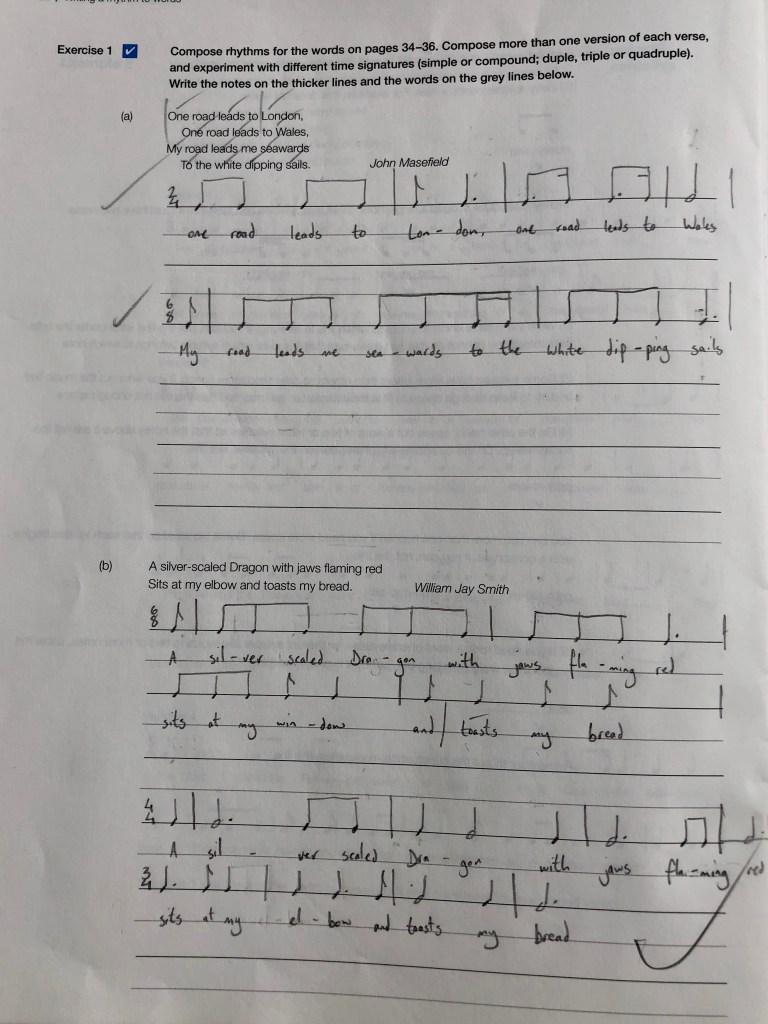

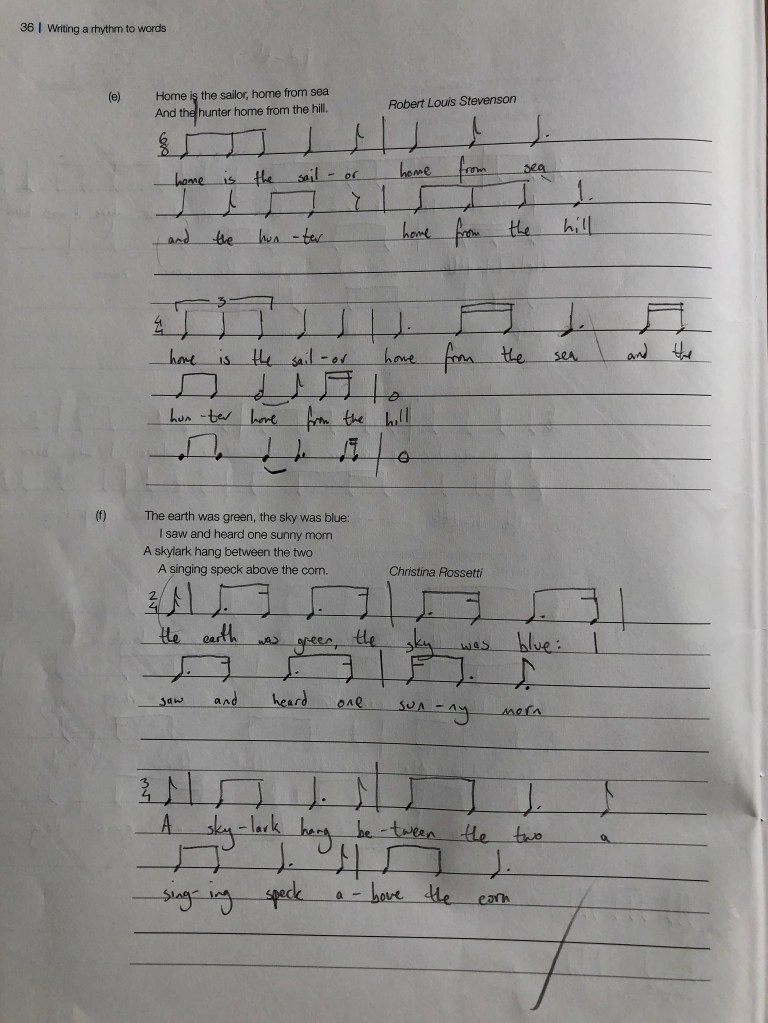
I was able to complete the Grade 4 workbook prior to beginning my first teaching placement. Whilst I knew it was unlikely that a student would require assistance in music theory (especially as this placement focused on BGE classes), I was glad to begin the placement with a much more solid foundation of music theory. Below are the General Exercises from the end of the Grade 4 workbook, which were corrected by John:

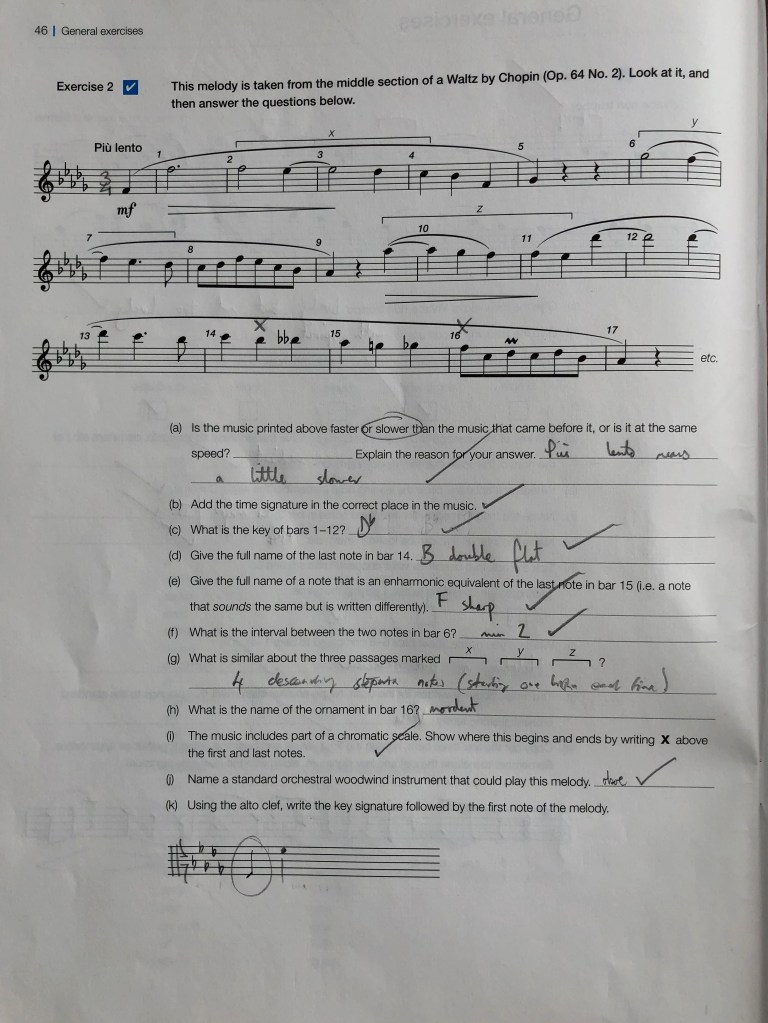


GTCS Registration standards require student teachers to “acquire knowledge and understanding of theory… in curricular areas” (2.1.2), and I feel the CPS class has certainly been useful in this regard. For fully registered teachers, this knowledge and understanding should be “detailed”, so in the time since my first teaching placement, I have continued working through the Grade 5 workbook, developing my understanding of concepts such as short/open score arrangements for voice, tuplets (quintuplets, septuplets, etc.) and more advanced performance directions, including German terms I was previously unfamiliar with.
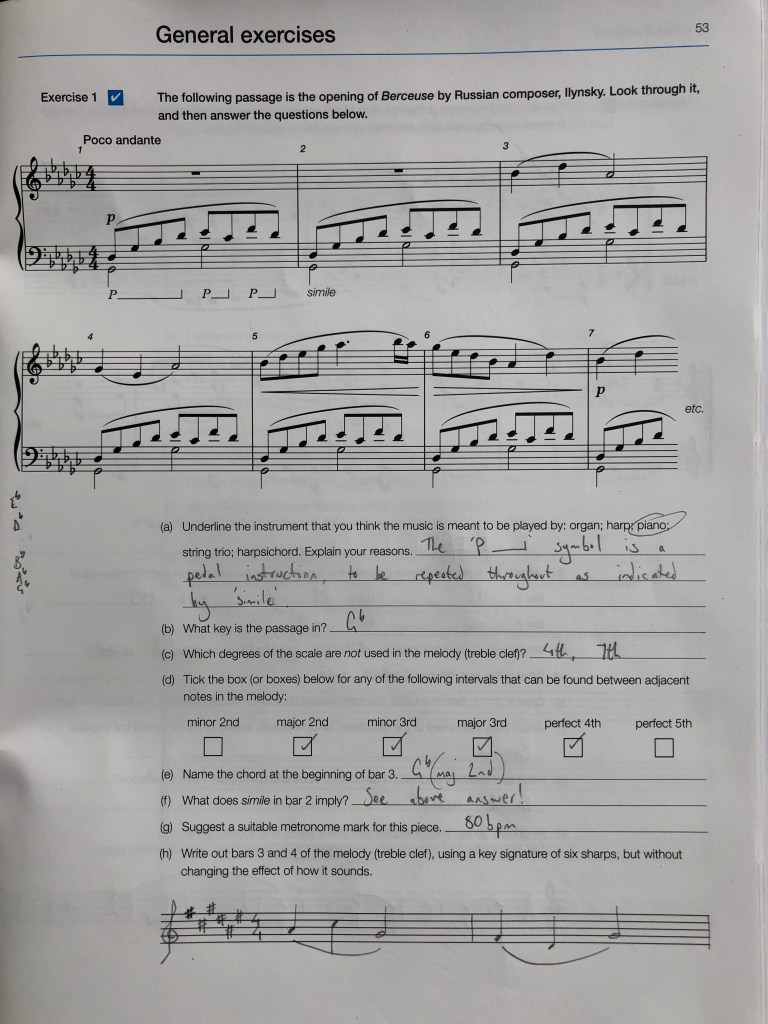
Below I have attached the General Exercises from the end of the Grade 5 workbook. At present they have not been corrected, but I hope to find time to have John (or another teacher) correct my work.


As I continue my professional development during this course and beyond, I feel a great deal more enthused about this aspect of music teaching, and how to continue progressing in this subject. I note that there are ABRSM theory workbooks for Grade 6 – 8, but also a First Steps in Music Theory book, which would prove useful should I be require to give students an introduction to this topic. The GTCS registration standards document makes reference throughout to providing a “challenge” for students (2.1.2, 3.1.4), and I believe that my own improved understanding of music theory means that I am in a better position to do so.
 Christopher's CPS